BHARAT AI AUTOMATION · PLC & SCADA

PLC & SCADA Automation

Bring machine signals, operator screens and production supervision into a coordinated automation project. Bharat AI Automation covers PLC programming, control panels and SCADA or HMI dashboards for factories and process plants, with live data, alarms and shift reporting shaped around the equipment and operating responsibilities at your site.
● ● ●
PLC & SCADA Automation
CONCEPT PREVIEW

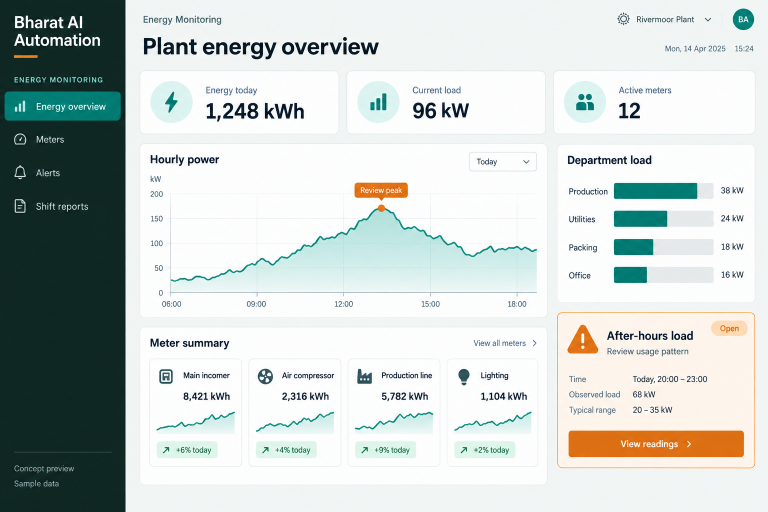
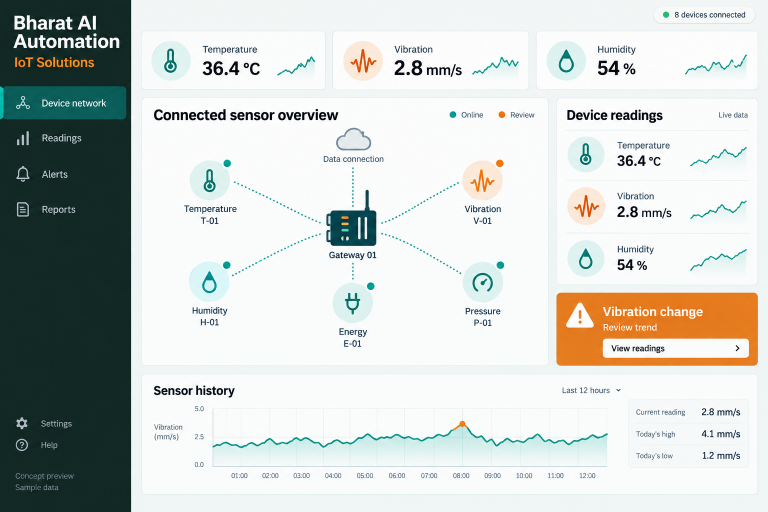
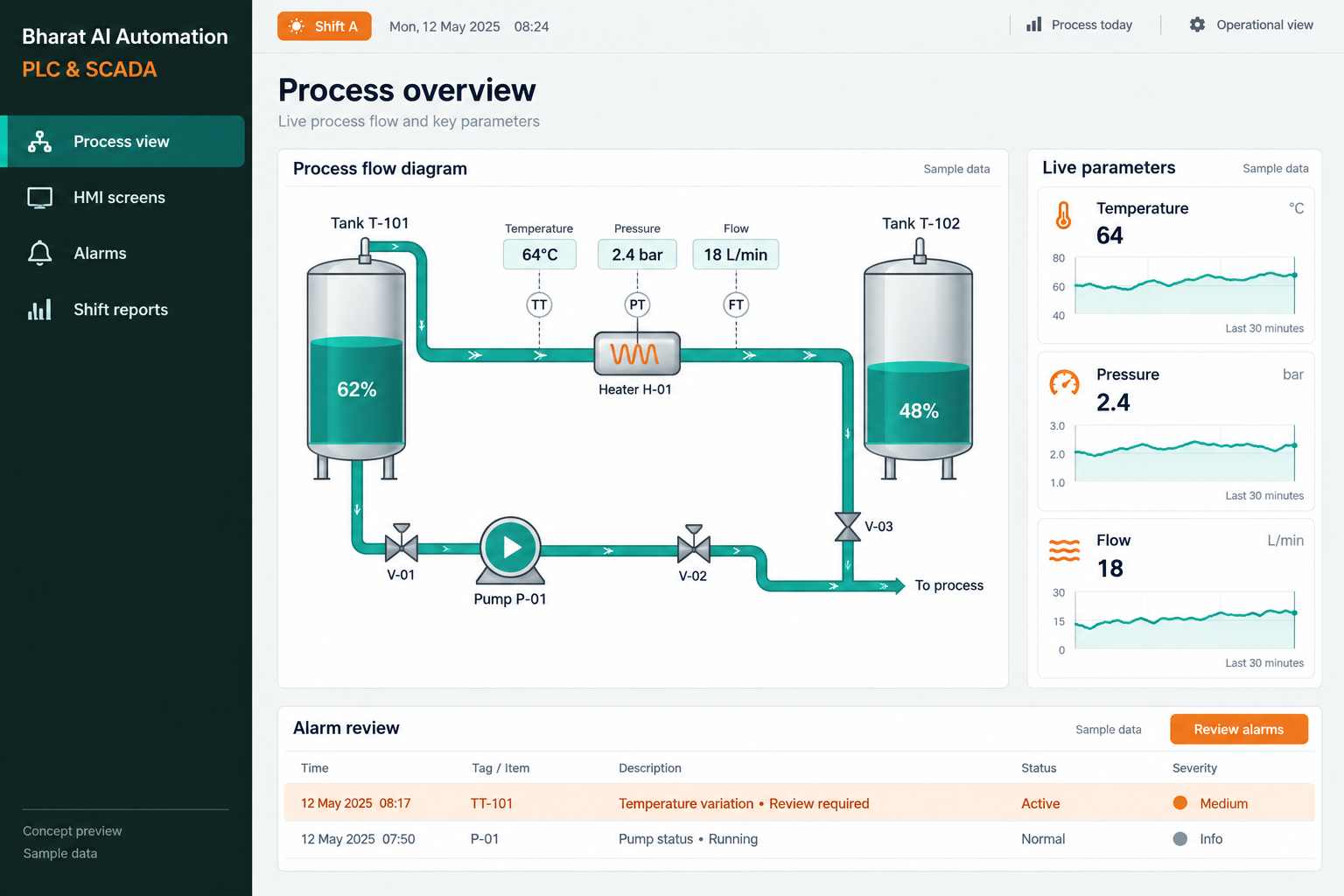
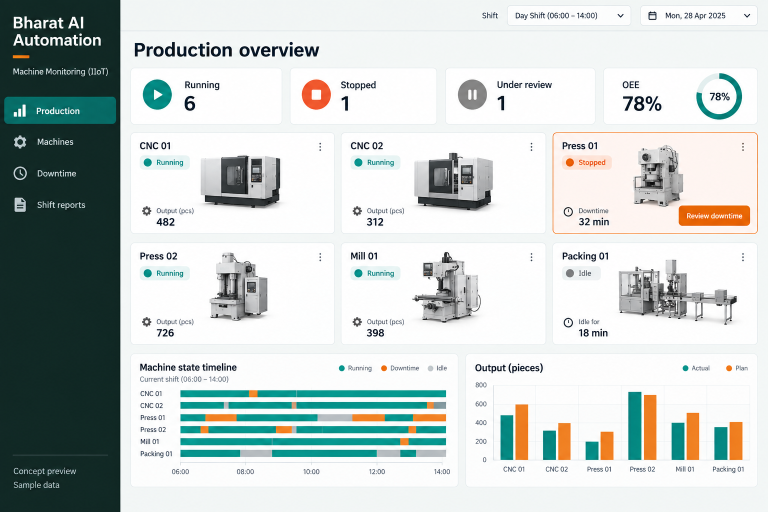
Illustrative interface with sample data. Select the image to explore it at full size.

BUILT FOR YOUR BUSINESS

A better fit for your daily work.

Food and process plants
Textile and rice mills
Manufacturing and engineering units
Plant operations and maintenance teams

Operators lack one process view

When production information is spread across machines and paper logs, teams struggle to explain current plant conditions.

Alarms have little context

An alarm is more useful when staff can review the associated value and production period.

Production reporting arrives too late

Manual end-of-shift compilation can obscure interruptions and changing conditions.

SOFTWARE CAPABILITIES

Everything your team needs, connected.

01

PLC programming and panels

Scope control requirements with the engineering team. Controller selection, existing logic, panel work and commissioning responsibilities are assessed for the project before agreeing the implementation.

02

SCADA supervision

Create a supervisory view of the agreed process signals, equipment states and alarms. The display should reflect what operators need to observe, with access and operating responsibilities defined before commissioning.

03

HMI operator dashboards

Present relevant machine information in a clear operator interface. Screen content and permitted actions are agreed with plant personnel so each role sees the information appropriate to its work.

04

Sensor and machine data

Collect the agreed temperature, pressure, flow or machine signals through supported interfaces. Confirm signal availability, units, sampling needs and equipment compatibility during the technical assessment.

05

Alarm and shift reporting

Keep alarms and production context available for shift review. Supervisors can distinguish a brief interruption from a recurring condition and assign investigation to the appropriate trained team.

06

Production and ERP context

Combine agreed production indicators with Bharat AI ERP requirements where needed. The integration scope identifies the records to exchange, their ownership and how exceptions will be reviewed.

HOW IT WORKS

From the first task to a clearer daily picture.

01

Define the process scope

Describe the equipment, operating sequence and reporting questions with plant engineers. Document responsibilities and the boundaries of the automation project before deciding which screens or interfaces to build.

02

Connect agreed signals

Qualified engineering personnel assess and commission the supported interfaces. Validate signal meaning and units so a dashboard does not present an apparently precise value with the wrong interpretation.

03

Supervise the operation

Operators use the agreed HMI or SCADA views during routine production. Authorised staff retain responsibility for control actions and the site’s existing operating and safety procedures.

04

Review alarms and trends

Investigate significant events using the relevant readings and production context. A software alert begins an assessment; it does not replace engineering judgement about the condition of equipment.

05

Use the shift evidence

Supervisors review output and interruptions with the team. Agreed reports help prioritise process improvement and maintenance discussions using a common record of the production period.

AI ASSISTANCE

Useful insights. Your team in control.

Use forecasts and alerts to guide your review, with people making the final decisions.

Maintenance pattern alerts

Where suitable historical data is available, predictive analysis can highlight patterns associated with equipment deterioration. These are advisory signals for trained maintenance personnel, not a promise to prevent every failure.

Production forecasting

Use recorded production patterns to estimate likely output. Supervisors interpret forecasts alongside product mix, planned stoppages and operational changes that may not be fully represented in the historical data.

Energy waste signals

Where meters are included, identify unusual consumption patterns for investigation. Plant personnel assess whether the variation reflects avoidable waste, production changes or a measurement issue before taking action.

REPORTS AND VISIBILITY

A clear view of what matters.

Process trends

Review the agreed signal history across a production period.

Alarm history

Inspect recorded alarms and their timing to understand repeated interruptions.

Shift production

Summarise agreed production measurements for shift discussions.

Machine and utility context

Bring selected equipment and energy readings into the same review period.

EQUIPMENT AND SETUP

Made to work with the right tools.

Bring your existing equipment details. We’ll review compatibility, connectivity and the modules needed for your installation.

YOUR SETUP CHECKLIST
GETTING STARTED

A practical plan for moving forward.

01

Engineering discovery

Review the process, equipment inventory and existing automation documents with responsible engineers. Agree the project boundary, operating requirements and commissioning responsibilities before proposing changes.

02

Design the information flow

Define signals, units, screens, alarm views and report calculations. Confirm which users can observe or operate each part of the system and what integration is required.

03

Validate with the plant team

Review the interface and data against representative operating scenarios. Qualified personnel complete the required site validation and retain responsibility for critical control and safety arrangements.

04

Commission and train

Agree an installation and commissioning plan with the site. Train operators on their screens and supervisors on reports, with support responsibilities documented for ongoing operation.

COMMON QUESTIONS

Before you choose your software.

Can you connect to our existing PLC?

Compatibility depends on controller models, accessible interfaces, existing program arrangements and project permissions. Share the equipment list and documentation so the engineering team can assess the available integration path.

The project scope determines what is supervised or controlled. Existing critical controls and safety systems are not assumed to be replaced, and qualified personnel must approve the engineering design.

Yes, agreed machine and sensor signals can be presented in SCADA or HMI dashboards. Update frequency and available readings depend on the equipment, connectivity and data collection design.

No system can promise that. Predictive alerts are advisory and depend on suitable data. Maintenance teams should investigate them alongside inspections, equipment guidance and established plant procedures.

ERP connectivity is part of the Automation offering. The exact production records, exchange frequency and reconciliation process are scoped around your plant and ERP requirements.

LET’S TALK ABOUT YOUR BUSINESS

See your workflow in action.

Bring your real tasks and questions. We’ll use them to discuss the right configuration, equipment and rollout.

A USEFUL STARTING POINT
KEEP EXPLORING

More ways to support your business.

BHARAT AI AUTOMATION

Understand what your machines produced, when they stopped and where the next investigation should begin.

BHARAT AI AUTOMATION

Turn meter readings into a useful view of how your plant consumes energy and utilities.

BHARAT AI AUTOMATION

Connect selected sensors, meters and devices to a shared operational view.