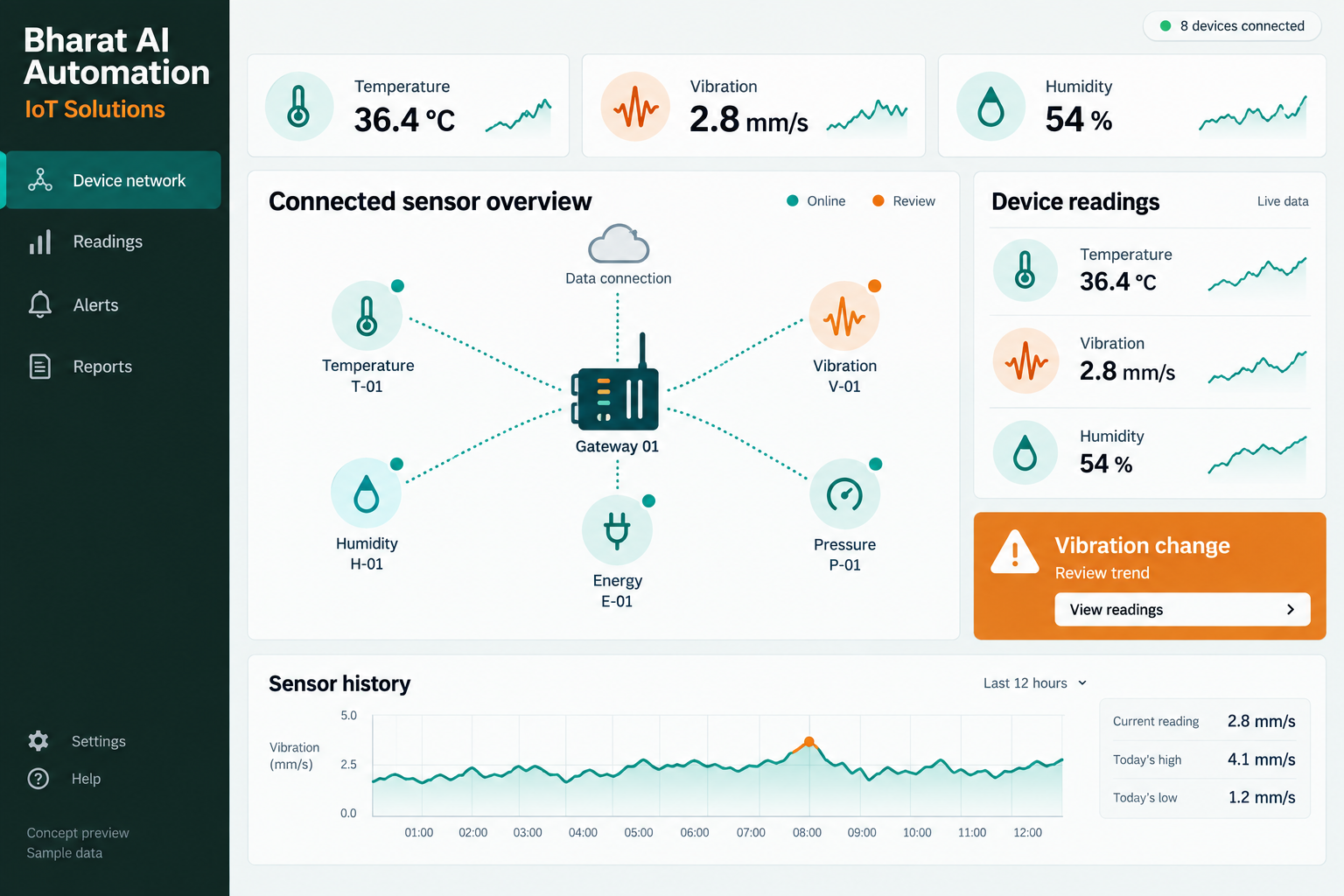
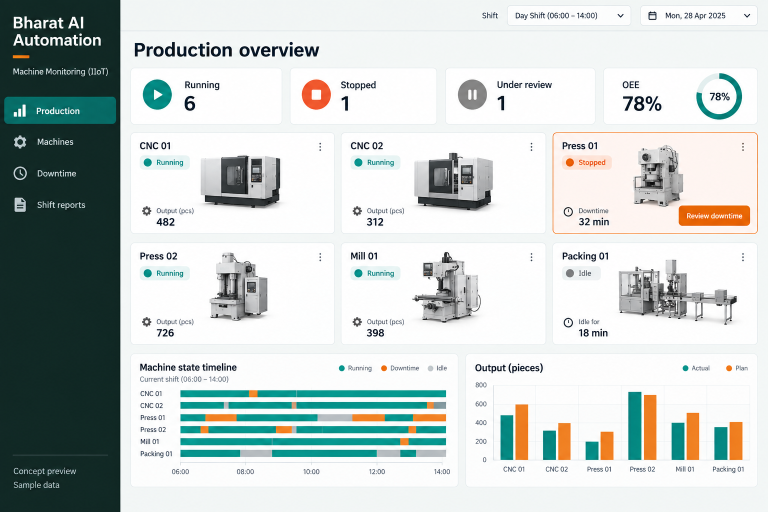
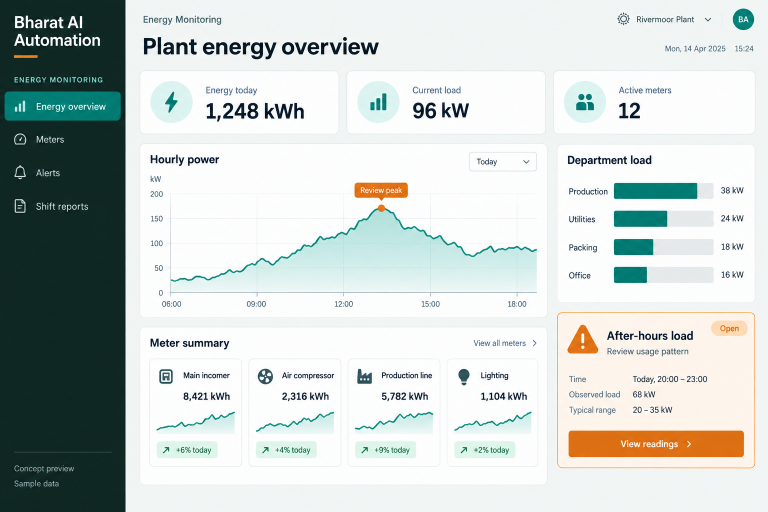
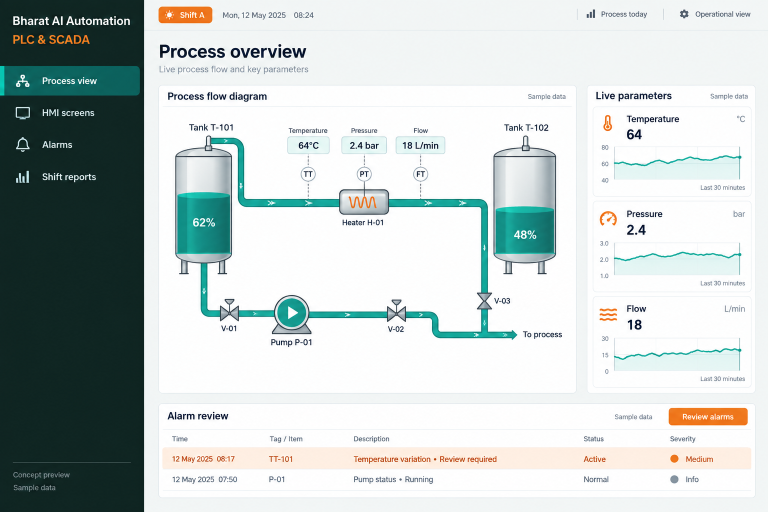
Connect selected sensors, meters and devices to a shared operational view. Bharat AI Automation brings monitoring, live readings and alerts into a site-specific IoT solution, helping teams investigate unusual patterns and connect useful operational information with production or ERP processes.
A temperature, pressure or meter value has limited value when staff must visit every device to read it.
Device data uses inconsistent meaning
Different units, labels and collection intervals make readings difficult to compare.
Alerts do not have clear owners
A notification is easy to ignore when nobody knows who should respond.
SOFTWARE CAPABILITIES
Everything your team needs, connected.
01
Sensor and meter connectivity
Collect agreed readings from supported industrial sensors and meters. Interface availability, device models and network conditions are assessed before confirming which equipment can be included.
02
Device monitoring dashboard
Present selected device information in a consistent view. Clear device names, locations and units help staff understand what a reading describes before comparing it with another point.
03
Live readings and trends
Follow current values and their recorded history within the agreed collection design. Update frequency depends on equipment and connectivity, so real-time expectations are defined during technical discovery.
04
Operational alerts
Configure relevant event notifications and route them to responsible people. Agree how staff handle missing readings, abnormal values and repeated events so the alerts remain actionable.
05
Scoped remote device control
Assess remote on/off control within a separate engineering scope. Authorisation, validation and site procedures are required; monitoring access alone does not permit staff to operate machinery.
06
ERP and production connection
Connect selected operational information with Bharat AI ERP or production requirements. Define which data is exchanged, how records are interpreted and who reviews inconsistencies before expanding the integration.
Identify the condition the team wants to observe and the decision it should support. Start with a specific operational question before choosing additional devices or dashboard screens.
02
Connect and name the devices
Qualified personnel assess supported connections and verify the readings. Agree consistent labels, locations and units so every dashboard value can be traced to the correct source.
03
Review the operating pattern
Observe normal readings across representative conditions. This gives the team context for interpreting later changes and helps identify measurement gaps before relying on alerts.
04
Investigate a notification
The responsible person checks the reading, device context and current operation. Staff distinguish a process change from a connectivity or measurement problem before selecting the appropriate response.
05
Expand with evidence
Confirm useful data and clear ownership in the pilot. Add devices or integrations when the team understands the operational purpose of each addition.
AI ASSISTANCE
Useful insights. Your team in control.
Use forecasts and alerts to guide your review, with people making the final decisions.
↗
Anomaly detection
Highlight readings or patterns that differ from the available history. An anomaly is a prompt to investigate, not proof of a fault, and its usefulness depends on representative operating data.
↗
Maintenance pattern guidance
For suitable equipment and data, predictive analysis can suggest conditions worth a maintenance review. Trained personnel interpret the guidance alongside inspections and retain responsibility for critical decisions.
↗
Energy and production insights
Where energy or production data is included, assess the relevant waste alerts and forecasts. These capabilities depend on the project measurements and should be demonstrated for the intended use case.
REPORTS AND VISIBILITY
A clear view of what matters.
↗
Device reading history
Review the agreed readings for a selected device and period.
↗
Alert activity
Inspect the events that triggered notifications and review recurring patterns.
↗
Shift or operating-period summary
Bring selected sensor and device information into routine operations reviews.
↗
Utility and production context
Where these measurements are included, review them alongside the monitored condition.
EQUIPMENT AND SETUP
Made to work with the right tools.
Bring your existing equipment details. We’ll review compatibility, connectivity and the modules needed for your installation.
YOUR SETUP CHECKLIST
Supported industrial sensors for agreed measurements
Meters and existing device interfaces assessed individually
Appropriate gateways and network infrastructure
Optional control equipment under a separate engineering scope
GETTING STARTED
A practical plan for moving forward.
01
Use-case discovery
Review the operational problem, device locations and responsible teams. Agree a focused monitoring scope and practical criteria for assessing its usefulness.
02
Connectivity assessment
Check device interfaces, network conditions and available readings. Confirm the collection design and equipment requirements before promising device reuse or a particular update rate.
03
Pilot and alert review
Validate readings against their sources and observe representative operation. Agree alert criteria with the people who will receive messages and investigate the resulting events.
04
Handover and support
Train staff to interpret dashboards and separate process issues from missing data. Document the support scope and assess additional devices only after the initial workflow is understood.
No universal compatibility is assumed. Connection depends on the device’s accessible interfaces, measurements and network arrangements. Share model details and the desired readings for a technical assessment.
How quickly do readings update?
The update rate depends on the equipment, connection and agreed collection design. The demo and technical scope should establish the latency needed for your monitoring case and whether it is achievable.
Can staff switch equipment on or off remotely?
Remote control is an available IoT use case, but each application needs separate engineering assessment, authorisation and validation. Critical controls remain the responsibility of trained personnel and the site’s procedures.
Does an anomaly mean a machine is failing?
Not necessarily. It means the observed pattern differs from the reference data. Staff should check operating changes, connectivity and measurement quality before deciding whether a maintenance investigation is needed.
Can we start with a few devices?
A focused pilot is a practical way to confirm connectivity, data quality and useful alerts. The rollout scope and expansion plan can then follow what the team learns from that deployment.
LET’S TALK ABOUT YOUR BUSINESS
See your workflow in action.
Bring your real tasks and questions. We’ll use them to discuss the right configuration, equipment and rollout.